
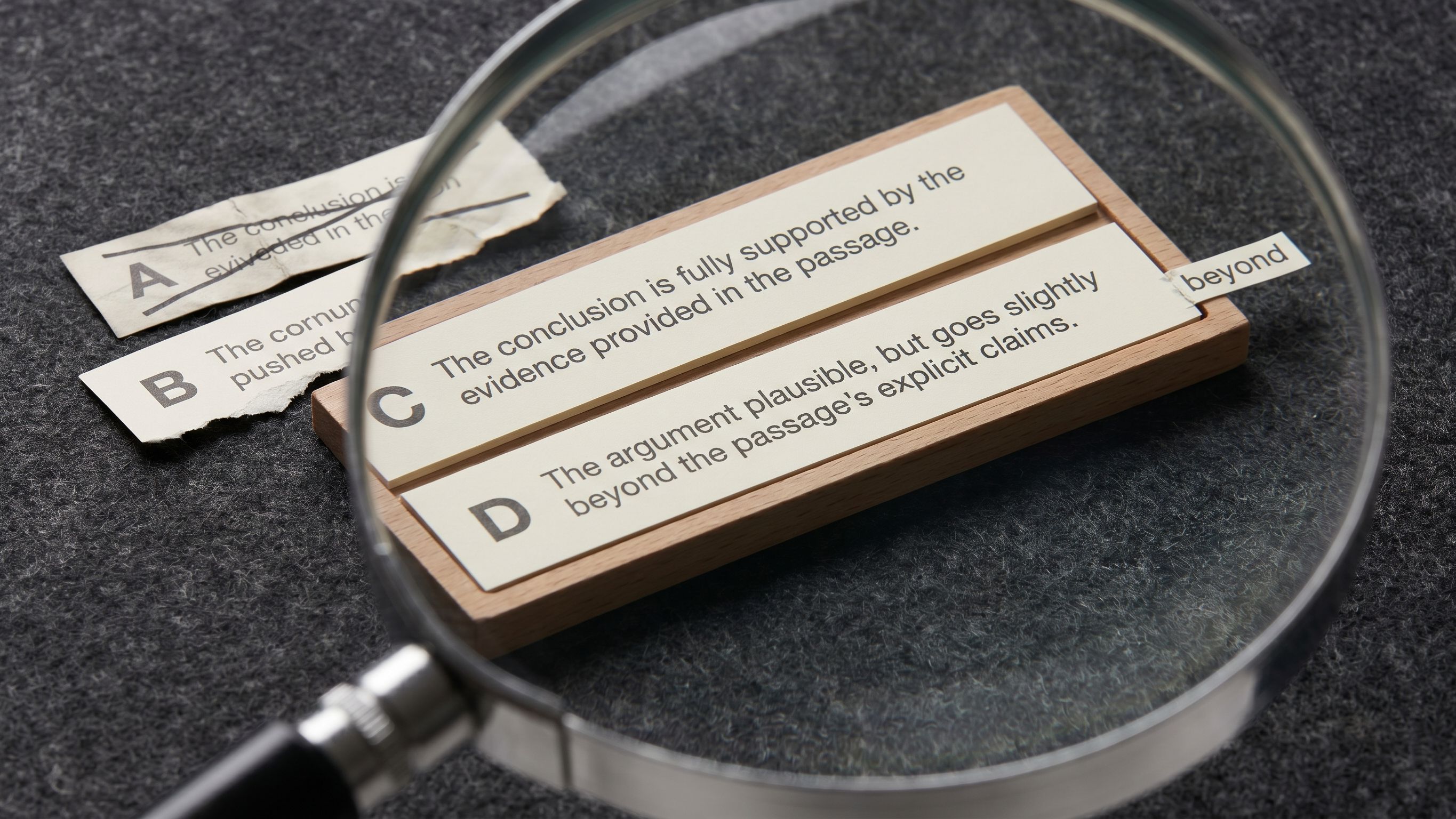
The 2-Answer Trap: Why CARS Gets Harder the Better You Get
Apr 25, 2026You know the feeling.
You read the passage. You understood it. You eliminated two answer choices immediately. And then you stared at the remaining two for 45 seconds, picked one, and found out later you picked the wrong one.
Every time.
Here is what makes this so frustrating: it is not a sign that you are bad at CARS. It is actually a sign that you are getting better. And that is exactly what makes it so hard to fix.
The Problem Nobody Talks About
Most CARS advice focuses on students who are struggling across the board: misreading passages, running out of time, missing the author's main point entirely. There is a lot of content out there for that student.
But there is a different student who does not get much attention. This student has put in real work. They are reading more carefully, managing time reasonably well, and getting through passages with a solid grasp of what the author is arguing. Their practice scores have improved.
And yet they keep getting stuck at the same spot: two choices left, and they pick the wrong one. Not randomly. Consistently.
This is the 2-answer trap. And the cruel irony is that the better you get at CARS, the more you will encounter it.
Why the 2-Answer Trap Gets Worse as You Improve
You get better at eliminating the obvious wrong answers
Early in your CARS prep, you might miss questions because you did not understand the passage well enough to eliminate anything. Every answer looked plausible. That is a different problem with a different fix.
As you improve, you get faster and more accurate at identifying the answers that are clearly out of scope, clearly contradict the passage, or use extreme language that does not match the author's tone. You eliminate two choices quickly and confidently.
That is real progress. You earned it.
But that leaves two choices that both look defensible
Here is where the trap closes.
The two answers you eliminated were genuinely wrong. The two you are left with are not both right. One is right. One is a well-constructed distractor.
The AAMC test designers are not trying to trick you with absurd wrong answers. They are trying to expose a specific reasoning gap. The distractors that survive your first round of elimination are designed to look correct using a specific type of flawed logic. They are built to target how most people think when they are looking for the right answer.
This is the part most students never stop to examine.
What Is Actually Happening When You Pick Wrong
You are looking for what is right, not what is wrong
When you have two answers left, the instinct is to read both and ask: which one could be correct? You build a case for each. You weigh them. You pick the one where you can construct a slightly better argument.
The problem is that this is exactly how people justify wrong answers. The distractor is designed to be justifiable. You can build a case for it. That is the whole point.
The answer you are looking for is not the one you can justify. It is the one you cannot disqualify.
The AAMC knows this and builds distractors around it
AAMC CARS wrong answers that survive early elimination tend to follow specific patterns. They often use language pulled directly from the passage, which makes them feel familiar and grounded. They make claims that are technically plausible but go slightly beyond what the passage actually supports. They address the right topic but answer a slightly different question than the one being asked.
None of this is random. AAMC test writers know that students in the 125-128 scoring range have learned to eliminate extreme answers and outside knowledge. So the distractors for those students look reasonable, passage-based, and specific.
If you are consistently scoring in that range and getting stuck at the 2-answer stage, you are not missing content. You are hitting the exact ceiling these questions are designed to create.
The Fix: Reverse Your Elimination Logic
Shift from 'Which answer could be right?' to 'What is wrong with this one?'
When you are down to two choices, stop trying to confirm one of them. Start trying to disqualify both of them.
Ask, for each remaining answer choice: what is wrong with this? Not could this be wrong, but what, specifically, makes this not the best answer?
You are looking for something concrete: a word that is too extreme, a scope that goes beyond the passage, a claim the author never made, a causal relationship the passage did not establish. If you can find something specific that disqualifies an answer, cross it out. The one you cannot disqualify is your answer.
This sounds simple. It is not. The reason it works is psychological. It is much harder to rationalize an answer you are trying to eliminate than one you are trying to confirm. The reversal stops you from building cases for the distractor.
How to apply this in real time
When you reach the final two choices, do not reread the passage immediately. First, pick up the question stem again and make sure you are clear on exactly what it is asking. Not the general topic. The specific question.
Then take each remaining answer and try to find the flaw. One word that does not fit. One claim the passage does not support. One relationship the author never asserted. If you find it, that answer is gone.
If you cannot find a flaw in either, go back to the passage with the question stem in mind and look for the specific piece of text that would confirm or deny each choice.
This is slower than your gut instinct. It is also more accurate.
What This Looks Like in Practice
Take a common scenario: the question asks what the author would most likely agree with. You have narrowed to two choices. Both seem reasonable.
Choice A is a restatement of something the author said, using slightly different language. It feels right because it echoes the passage.
Choice B is a broader claim that the passage seems to be building toward, even if the author never stated it directly.
The instinct is to pick B because it feels like the deeper, more complete answer. But the question asked what the author would agree with, not what conclusion might follow from the argument. Choice A stays within the passage. Choice B extrapolates beyond it.
Apply the reversal: what is wrong with B? It goes further than the author's stated position. The author never claimed that. That is a disqualifying flaw.
Choice A survives. Choice A is correct.
This kind of reasoning is not obvious in the moment. It is a skill you have to build deliberately.
The Bigger Pattern: CARS Rewards a Specific Kind of Thinking
The 2-answer trap exists because CARS is not a reading comprehension test in the way most premeds have experienced it. It is a test of whether you can distinguish between what a passage says and what sounds like a reasonable extension of what it says.
Most students study by reading more passages and checking their scores. That builds familiarity, but it does not build this specific skill. The skill comes from deliberate review: looking at the wrong answer you chose, figuring out why it looked right, identifying the specific reasoning error, and naming it so you can catch it next time.
Students who move from 126 to 129 do not do it by reading twice as many passages. They do it by understanding exactly why they keep missing the same type of question and fixing that reasoning pattern directly.
Next Step
If you want a complete system for this, the CARS Mastery Program covers the 9 most common wrong-answer trap types in CARS, including exactly how to identify them in real time and a four-step elimination protocol you can apply to any question.
It also includes three annotated passage walkthroughs and a 4-week practice plan built around score improvement, not just passage volume.
You can get access right here before the price goes up!
WANT MORE USEFUL PREMED CONTENT?
Join Mebo Minutes and get notified of new posts, free resources, and high-yield study systems!
We hate spam. We will never sell your information, for any reason.