
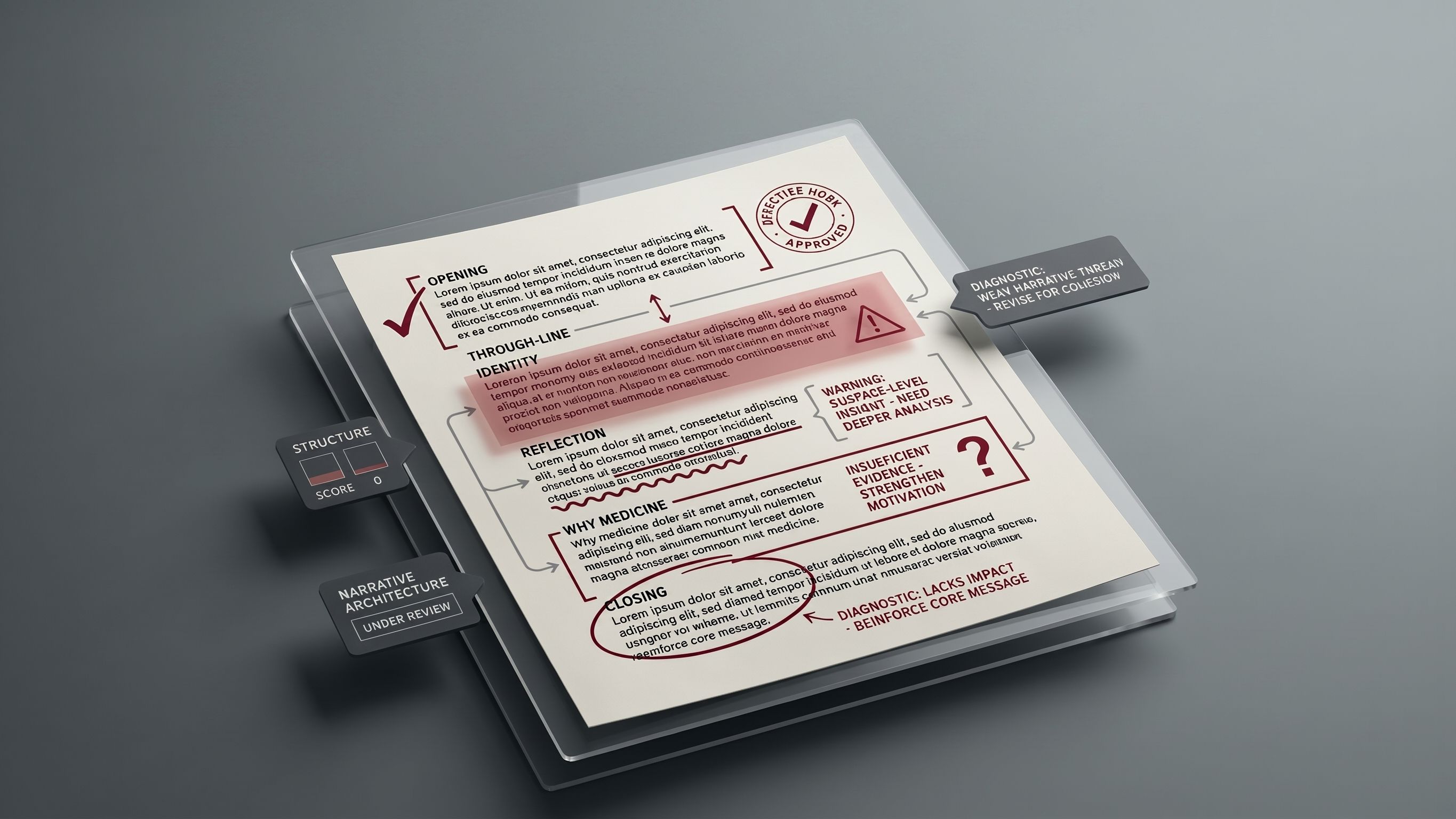
The Night Before AMCAS Opens: Is Your Personal Statement Actually Ready?
May 03, 2026AMCAS opened today.
You can submit your application in 23 days.
And if you're like most applicants reading this, you have a personal statement draft sitting in a Google Doc somewhere. Maybe it's gone through three revisions. Maybe ten. Maybe you've sent it to your pre-health advisor, your roommate, your mom, and one person from your pre-med groupchat who got into medical school two years ago.
And yet something still feels off.
Here's the thing: most applicants do not have a bad personal statement because they wrote badly. They have a bad personal statement because they evaluated it wrong. They asked "does this sound good?" when the actual question is "does this do what it needs to do?"
Those are not the same question.
I've read hundreds of personal statements at this point. The ones that fail are not the ones with grammar errors. They're the ones that feel complete on the surface and hollow underneath. The opening hooks you and then drops you. The experiences are described but never explained. The identity is hinted at but never stated. And the applicant submits it because everyone who read it said it was "really good."
This checklist is not here to make you feel good. It's here to show you where your statement actually stands before AMCAS transmission day on June 26th -- when your file starts moving through adcom pipelines without you in the room.
Work through each section honestly. A "No" or "Not sure" is information. Most applicants who discover a problem here still have time to fix it before their first submission date of May 28th.
How to Use This Checklist
Read each question. Answer yes or no -- no partial credit. If you're not certain, mark it No.
At the end, tally your No answers. The scoring guide at the bottom tells you what to do next.
Section 1: The Opening
The opening is the only part of your statement guaranteed to be read. Adcoms have said directly that if the first paragraph doesn't earn their attention, they move on. That's not a metaphor. It's how it works when someone has reviewed 40 essays in a day.
Question 1: Does your opening put the reader inside a specific moment?
Not a reflection, not a general observation, not a thesis statement -- a scene. A specific place, a specific person, a specific thing that happened. The opening lines of the strongest personal statements make you feel like you're watching something, not being told something.
Weak: "Growing up, I always knew I wanted to help people."
Stronger: "The attending hadn't looked up from the chart in three minutes. The patient was still talking."
Yes / No
Question 2: Does your opening avoid the four most common rejected openers?
These are the openers adcoms flag as immediate signals of an unfocused essay:
- "I have always wanted to be a doctor since..."
- "Medicine is a field that combines science and compassion..."
- "When my [family member] was diagnosed with [illness], I knew..."
- "Dictionary definitions" as an opening device
If your opening is a variation on any of these, mark No -- not because they can never work, but because they require exceptional execution to recover from, and most drafts that start here don't.
Yes / No
Question 3: Can your opening paragraph stand alone as a complete hook?
Read only your first paragraph. Would a stranger who knew nothing about you want to keep reading? Could it survive being the first thing an adcom sees on a day when they're reading applications back to back?
Yes / No
Section 2: The Through-Line
This is the section where most personal statements fail. Not in structure. Not in grammar. In coherence. A through-line is the single idea that connects every experience you mention to the same answer to the question "why medicine." Without it, your statement reads like a list of things that happened to you.
Question 4: Can you state your through-line in one sentence?
Try it right now. Fill in the blank:
"My personal statement argues that I am the kind of doctor who __________ because __________."
If you cannot complete this sentence, your statement does not have a through-line. It may have a theme -- a topic or an experience you return to -- but a theme is not a through-line. A through-line is directional. It moves somewhere. It builds to an identity claim.
Yes / No
Question 5: Does each body paragraph connect back to that through-line?
Go paragraph by paragraph. After reading each one, ask: does this move my argument forward, or does it just describe something I did? Description is not argument. An adcom already has your activity list. What they need the personal statement to do is tell them why those activities point to the same kind of doctor.
If any paragraph is only descriptive -- if it tells what happened without connecting it to what you're claiming about yourself -- mark No.
Yes / No
Question 6: Would an adcom reading only your personal statement know what kind of physician you intend to be?
Not your specialty. Not your career goals. The kind of physician. The values you'll bring to the room. The lens you'll use to see patients. This is not the same thing as writing "I want to be a compassionate doctor." That's a sentence, not an identity. The strongest statements show you as a specific person with a specific way of seeing medicine -- so specific that an adcom could describe you accurately to the rest of the committee without referring back to the document.
Yes / No
Section 3: The Experience Descriptions
Most applicants spend the most time on this section. Most applicants also get it wrong in the same way: they describe what they did, not what it changed. Adcoms can read your W&A section. They don't need the experience summarized. They need to understand what it means.
Question 7: Do you spend more time on insight than description?
For each experience you reference in your personal statement, count the sentences of description (what happened) vs. the sentences of reflection (what it changed, what you understood differently, what it showed you about medicine or about yourself). If description outnumbers reflection in any experience, that section is underwritten.
Yes / No
Question 8: Are you using two or three experiences maximum?
This is a consistent pattern in rejected statements: too many experiences, not enough depth on any of them. 5,300 characters is not enough space to go deep on four or five distinct experiences. Applicants who try to cover everything end up covering nothing. The strongest personal statements choose two to three moments and excavate them fully.
If you're referencing four or more separate experiences in your statement, mark No.
Yes / No
Question 9: Does at least one experience show something uncomfortable -- a moment of uncertainty, failure, or genuine learning?
Adcoms are not looking for proof that you're perfect. They're looking for evidence that you're self-aware. A statement that describes only clean wins and clear confirmations of your calling reads as either dishonest or unexamined. The applicants who stand out are willing to show a moment where they didn't know something, got it wrong, or had to change their thinking. That's what maturity looks like on paper.
Yes / No
Section 4: The Identity Test
This is the hardest section and the most important one. The identity test is a single question that the entire personal statement must pass. I use a version of it on every statement I review.
Question 10: Could another applicant have submitted this exact statement?
Read your personal statement imagining you've removed your name. Does anything in it -- the specific experiences, the specific insight, the specific way you describe what medicine means to you -- only belong to you? Or is it interchangeable with the statement of any other premed who volunteered in a clinic and shadowed a physician?
If someone else could have written it, it's not doing its job. The goal is not to be unusual. The goal is to be specific enough that you become recognizable.
Yes / No
Question 11: Do you tell the reader why medicine specifically -- not nursing, not social work, not public health?
This is one of the most common gaps I see. The applicant describes deep empathy, a passion for helping underserved communities, and a fascination with how illness affects families. Every one of those things is true of excellent nurses, social workers, and public health professionals. The statement never explains why those same values lead specifically to medicine. Medicine requires justification that goes beyond "caring for people." If your statement doesn't make that argument, mark No.
Yes / No
Question 12: Does your closing paragraph land somewhere new -- not just summarize?
A closing that restates what the reader already read is not a close, it's a retreat. The strongest closing paragraphs return to the emotional center of the opening and push forward: here is who I am, here is where I am going, here is what kind of doctor I'm becoming. The reader should finish your statement feeling like they just watched a journey reach its destination -- not like they got a summary of a journey they already watched.
Yes / No
Section 5: The Structural Audit
These are the technical checks. They're not as important as Sections 2 and 3, but they're faster to fix and they matter.
Question 13: Have you read the statement out loud, in full, from beginning to end?
This is not optional. Reading silently lets you read what you intended to write. Reading aloud forces you to read what's actually there. Awkward transitions, clunky sentences, and pacing problems that you've read past fifty times will surface immediately when you hear them. If you haven't done this yet, you have not finished editing.
Yes / No
Question 14: Is every sentence doing something?
Go line by line. For each sentence, ask: does this move the reader forward? Does it add information, deepen the scene, or develop the argument? If a sentence could be deleted without losing anything, delete it. Personal statements that use all 5,300 characters are not stronger than statements that stop at 4,800 -- they're often weaker, because the extra characters are usually occupied by filler that dilutes what came before it.
Yes / No
Question 15: Does your statement avoid these specific red flags?
Check for the following and mark No if any are present:
- Restating your GPA or MCAT score
- Quoting a physician, philosopher, or public figure in your opening
- Starting more than two sentences in a row with "I"
- Using the word "passionate" or "passionate about medicine"
- Referring to doctors as heroes or saviors
- Describing a family member's illness as the entire reason you want to be a doctor, with no additional development
Yes / No
What Your Score Means
Tally up your No answers.
0 to 2 No's: Your statement is in strong shape. Focus on one final out-loud read, make targeted edits, and submit with confidence during the first two weeks after submission opens on May 28th.
3 to 5 No's: Your statement has real gaps that will hurt you. You have time to fix them before the June 26th transmission window when schools start receiving applications. Don't submit yet. Prioritize the questions in Section 2 (Through-Line) first -- those are the changes that move the needle most.
6 to 9 No's: Your statement needs structural work, not surface edits. Line-level polishing will not fix a through-line problem. The narrative architecture has to come first. Give yourself at least two full revision cycles before you submit. You still have time, but not much.
10 or more No's: Submit after June and not before. I know that's not what you want to hear, but a late submission with a strong statement outperforms an early submission with one that doesn't pass this checklist. The students who regret their applications almost never regret submitting one week later. They regret submitting a statement that wasn't ready.
Where to Get Help
If you worked through this checklist and found gaps you don't know how to close, here's what we offer at MedBound.
AWL Essentials is the starting point if you need a thorough diagnostic review of your personal statement before you commit to a full revision. I read your statement from the perspective of what it's actually arguing -- not line by line, but top-down -- and return a written breakdown of exactly where the through-line holds, where it breaks, and what needs to happen before we touch individual sentences. If you're sitting at three to six No's on this checklist, this is where to start.
AWL Advantage is built for applicants who want the full revision cycle handled end-to-end. You get the diagnostic review, iterative editing across multiple drafts, and line-level work once the narrative architecture is locked in. If you're at seven or more No's, or if you simply don't want to navigate the revision process alone during a cycle that opens tomorrow, Advantage is the right level.
Both tiers are designed around one principle: narrative has to come before line editing. Most editing services skip straight to fixing sentences. We don't, because a well-written statement built on the wrong foundation will still fail this checklist.
Applications open in 23 days. Review turnarounds at the Essentials level run within 48 to 72 hours. There's still time -- but not unlimited time!
Get your personal statement and work & activities reviewed by our experts!
WANT MORE USEFUL PREMED CONTENT?
Join Mebo Minutes and get notified of new posts, free resources, and high-yield study systems!
We hate spam. We will never sell your information, for any reason.