
Why Free Personal Statement Feedback Is Hurting Your Application
Apr 12, 2026Every year, tens of thousands of premed students do the same thing before AMCAS opens.
They write a draft, or something close to one, and then they start asking around. They post in r/premed. They DM someone on SDN who said they got into a T20. They send it to their roommate who's a great writer. They ask their pre-health advisor to take a look. They paste it into ChatGPT and ask for a critique.
And almost all of them walk away from that process thinking they're getting closer.
Most of them are not.
This isn't about whether those people mean well. They do. The problem is more specific than that, and it's worth understanding before you spend another two weeks chasing feedback that is pointing you in the wrong direction.
The Free Feedback Cycle Premeds Are Stuck In
Here is what the typical free personal statement review looks like in practice.
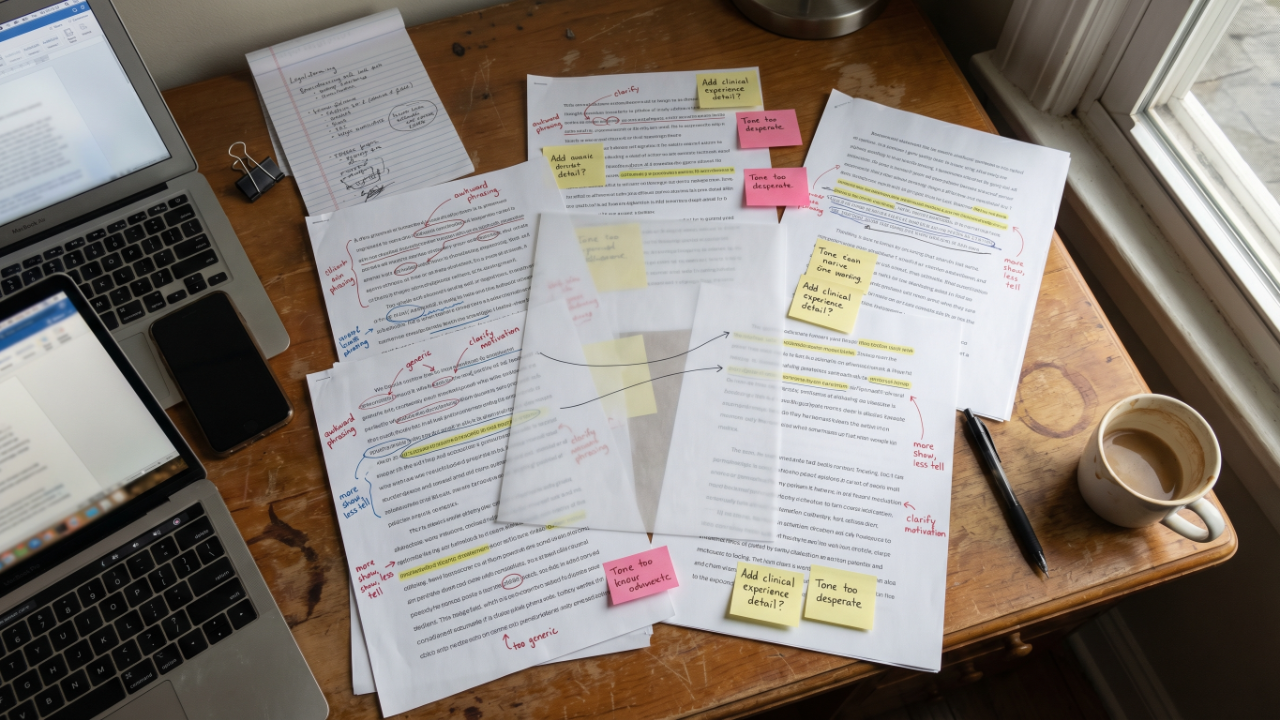
You send your draft to someone, they read it, and they tell you: the opening is slow, this paragraph is confusing, you should maybe cut the part about your grandmother, your conclusion feels rushed, and your sentence variety could be better.
Some of that might even be accurate.
But here's the question none of those reviewers are asking first: does this essay actually have a central argument about who you are as a person? Not just why you want to be a doctor, but what specific quality, perspective, or way of seeing the world is running through every paragraph of this thing?
Because if the answer to that question is no, then cleaning up the sentences and tightening the opening is not helping you. It is making a weak essay look more presentable. You are getting line edits on a draft that is not ready for line edits yet.
That is the cycle. And most premeds stay stuck in it for months.
I Watched This Happen at a University Writing Center
Before MedBound, I spent time as a tutor at my university's writing center. I worked alongside other tutors, many of them strong writers, some of them pre-health students themselves, all of them genuinely trying to help.
And here's what I noticed.
When a premed student came in with a personal statement, the session almost always followed the same pattern. The tutor would read it once, maybe twice. They would underline a few sentences that sounded unclear. They would ask the student whether the opening grabbed them. They would suggest cutting things that felt redundant. They would send the student away with a marked-up copy and a plan to fix the parts that felt rough.
That's it.
What the Tutors Were Actually Qualified to Do
They were qualified to assess writing quality. Sentence structure, clarity, word choice, flow from paragraph to paragraph. That is legitimate feedback and it has real value when the essay is actually ready for that level of review.
What They Were Not Qualified to Do
They were not trained to look at a personal statement and ask: what is the central identity claim this essay is making? Is there a single through-line connecting every paragraph? Does this essay tell me something specific and memorable about this person, or does it just explain their path to medicine in chronological order?
Those are different questions. They require a different skill set. And almost nobody who reviews personal statements for free is asking them first.
What I watched, over and over again, was students walking out of the writing center with a grammatically cleaner essay that still had no coherent narrative at its core. They felt like they were making progress. The essay looked better on the surface. But the underlying problem had not been touched.
The Difference Between Editing and Diagnosing
When a student submits their personal statement to MedBound's Admissions Writing Lab, the first thing we look for is not a grammar issue or a formatting problem.
We look for narrative differentiation.
Every applicant has a story. Every applicant has experiences that shaped them. But most personal statements read like a timeline of activities rather than an argument for a specific kind of person. They describe what the student did without making clear what those experiences reveal about who they are.
What we are looking for is a through-line. One clear throughline that can connect the personal statement to the work and activities section, to the secondary essays, to how the student would present themselves in an interview. The kind of narrative coherence that makes an adcom reader finish the essay and feel like they actually know the person.
That is a diagnostic question, not an editing question. It has to come first. If you do not answer it before you start revising, you are not moving forward. You are just rearranging paragraphs.
What Adcoms Are Actually Looking For (And Why Generic Feedback Misses It)
Admissions committees at most medical schools read thousands of personal statements every cycle. The ones they remember are not the ones with the smoothest prose. They are the ones where the reviewer finishes reading and has a clear, specific sense of the applicant as a person.
Not "she wants to help people" or "he was inspired by his grandfather's illness." Those show up in hundreds of essays. What sticks is something far more specific: a particular way of thinking, a combination of experiences that makes sense only for this person, a voice that feels genuinely individual.
The most common trap applicants fall into is writing about experiences they think adcoms will be impressed by, rather than experiences that reveal who they actually are. The result is an essay that reads as competent but forgettable.
Free reviewers cannot fix this problem because they do not know what they are looking for. Your roommate who's a great writer is evaluating the essay as a piece of prose. Your pre-health advisor is checking it against a mental template of what personal statements are supposed to look like. Neither of them is reading it the way an adcom would, and neither of them is trained to find the narrative gap between who you are and what your essay is communicating.
What a Real Narrative Through-Line Looks Like
Here is a concrete example of the difference.
Student A writes a personal statement that covers three experiences: volunteering in a clinic, doing research, and shadowing a surgeon. Each paragraph is well-written. The transitions are smooth. The conclusion ties back to the opening. A peer reviewer would read it and think it looks solid.
But ask the diagnostic question: what is the one thing this essay tells me about who this student is as a person? What does this applicant see or notice or care about that another applicant with the same experiences would not? And the essay has no answer. It describes a path. It does not make an argument.
Student B writes a personal statement built around a specific observation they kept returning to across all three experiences: the moment when a patient decides whether or not to trust a doctor, and what actually determines that outcome. Every experience in the essay connects back to that observation. The adcom finishes reading and thinks: this person has a specific way of seeing patient relationships. I want to interview them.
The through-line is what creates that second outcome. And finding it is not something a peer reviewer, a writing center tutor, or an AI chatbot is equipped to do for you.
The Problem With ChatGPT, Reddit, and Your Pre-Health Advisor
Let's be direct about each of these.
ChatGPT will make your essay sound cleaner. It is very good at identifying awkward phrasing and suggesting smoother alternatives. But it has no way of knowing whether your essay has a coherent narrative identity, because it has no context for who you actually are. It will optimize the writing without diagnosing whether the writing is communicating the right thing. If your essay has no through-line, ChatGPT will give you a polished essay with no through-line.
Reddit and SDN peer reviewers mean well, but they are applicants, not admissions professionals. The sample personal statements you find on Reddit and Student Doctor Network are the same ones that everyone else is looking at and attempting to imitate. The feedback you get from that ecosystem tends to be pattern-matched against what accepted essays look like on the surface, not what makes them work underneath. You may end up revising toward a generic version of a "good" personal statement rather than toward your actual story.
Pre-health advisors vary significantly in their preparation. Many are excellent at knowing AMCAS requirements, deadlines, and general guidance on what medical schools look for. Very few have been trained to do a deep narrative audit of a personal statement. Their feedback is often shaped by what worked for students in prior cycles, which tells you very little about how to differentiate your specific application this cycle.
None of these are bad people or bad resources for everything. But for the specific problem of narrative diagnosis on a personal statement, they are not the right tool.
What to Do Instead
Before you ask a single person for feedback on your personal statement, answer these questions in writing:
1. What is the one specific quality or perspective that connects all of my most meaningful experiences? Not "I care about people" or "I want to help underserved communities." Something more precise. The way you think about a problem. How you respond to uncertainty. What you notice that other people miss.
2. If an adcom read only your personal statement and nothing else in your application, what would they know about you as a person? Write out your answer. Then go read your essay and see if your answer actually appears in it. Most of the time, there is a significant gap between what you intend to communicate and what is actually on the page.
3. Does every paragraph in your essay connect back to the same core identity claim? If any paragraph could be lifted and dropped into another applicant's essay without anyone noticing, it is not yet doing the right work.
If you cannot answer these questions clearly, the essay is not ready for line editing. It is ready for diagnosis.
That is exactly what the MedBound Admissions Writing Lab is built to do. We start with a full narrative audit before we ever look at sentence-level craft. We identify whether your through-line exists and whether it is actually doing the work of differentiating you. And then we go deep, line by line, through every section.
The students who come to us after circulating their drafts through the free feedback cycle almost always say the same thing: they had no idea the real problem was this far upstream.
That upstream work is where the application either starts working or stays stuck.
Start with a full narrative audit. See what MedBound can do for your personal statement.
Summary
Getting free feedback on your personal statement is not the problem. Getting the wrong kind of feedback before the right kind of questions have been answered is. Most free reviewers, including peer editors, pre-health advisors, ChatGPT, and Reddit commenters, are evaluating writing quality. They are not diagnosing whether your essay has a coherent narrative identity. That distinction matters more than almost anything else in the personal statement, and it has to come first. Start with the diagnostic questions. Find your through-line. Then get the kind of deep-dive review that can actually move your application forward.
WANT MORE USEFUL PREMED CONTENT?
Join Mebo Minutes and get notified of new posts, free resources, and high-yield study systems!
We hate spam. We will never sell your information, for any reason.